Cyber security
Do you want to work professionally with cyber security, networking, and data security?
The Bachelor’s Degree Programme in Cyber Security equips you with strong competencies in IT security, data protection, and the secure operation of digital systems.
You will specialise in cyber security and learn how to protect businesses and organisations against cyberattacks, safeguard sensitive data, and identify vulnerabilities in IT systems.
Cyber security is a rapidly growing field, and professionals with expertise in IT security are in high demand across a wide range of industries. Throughout the programme, you will develop the skills needed to protect digital solutions and contribute to a secure digital future.
Our Bachelor's Program in Cyber Security will start up in September 2027.

Facts
Title
Cyber Security
Education Level
Bachelor Degree - 195 ECTS points
Duration
3¼ years
Internship
6 months internship
Study Start
September 2027
Location
Viborg
Language
English
Course content
Overall, the programme comprises the following three subject areas:
1. Cybersecurity Management, Governance and Processes
This subject area covers knowledge of governance, management tools and processes for preventing, monitoring, detecting and responding to threats to the confidentiality, integrity and availability of systems and applications.
It addresses the independent organisation and management of cybersecurity activities within organisations and businesses, as well as cybersecurity principles, standards and best practices, including the ethical, legal, political and managerial aspects of cybersecurity.
2. Network Security, Detection and Architecture
This subject area covers network architectures, transmission media and protocols, as well as tools for preventing, monitoring, detecting and responding to threats to the confidentiality, integrity and availability of network communications.
It also covers the technical components that constitute different IT systems.
3. Software and Data Security and Automation
This subject area covers security aspects of software, including software quality and the implications of error handling and data management for vulnerabilities in software architecture.
It also addresses security design principles, as well as encryption and data storage measures, automation, basic scripting and programming.
These three overall subject areas are reflected in the following 11 national subject elements.
Curriculum
-
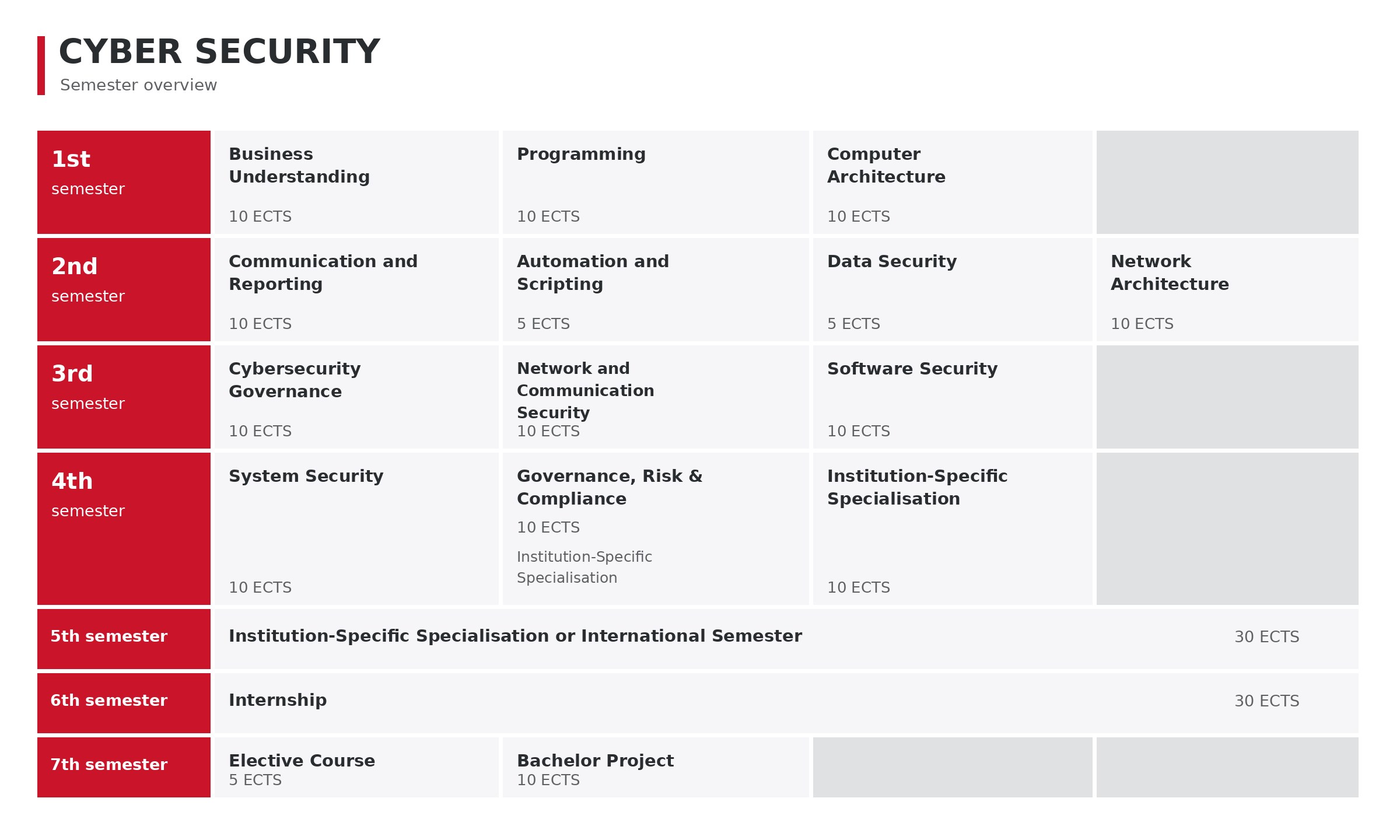
Semester 1
Business Understanding – 10 ECTS
This subject element covers general business understanding and value creation within organisations, including different types of businesses and their value chains. It explores the relationship between business operations, information technology and cybersecurity.The subject element introduces cybersecurity maturity, including governance and risk management, as well as the role of the cybersecurity professional within an organisation.
Programming – 10 ECTS
This subject element covers fundamental programming using a programming language that meets industry standards for scripting, particularly in the context of cybersecurity.Topics include data types, data structures and theoretical concepts such as operators, conditional statements and control flow. Additional emphasis is placed on functions, parameters and input validation.
The subject element also addresses data from sources such as log files and databases, as well as the use of predefined modules and third-party libraries to solve specific problems. Furthermore, it focuses on the independent development of tools and programs for analysing and processing such data.
Documentation is an integral part of the subject element, with an emphasis on communicating functionality and facilitating knowledge transfer.
Computer Architecture – 10 ECTS
This subject element examines how the individual components of a computer, including hardware, operating systems and software, interact with one another. It also explores their respective functions and the implications of these functions for cybersecurity.
-
Semester 2
Communication and Reporting – 10 ECTS
This subject element focuses on effective communication about cybersecurity within an organisation, including the development of a cybersecurity culture, cybersecurity awareness training and crisis communication. It also covers data collection, metrics, visualisation, communication and presentation of cybersecurity reports within an organisation, both orally and in writing.
Automation and Scripting – 5 ECTS
This subject element focuses on acquiring knowledge and understanding of the programming aspects of automation from a cybersecurity perspective.Topics include the development and configuration of services across different operating systems, for example for monitoring or performing repetitive operations that need to run without user intervention.
The subject element also emphasises the use of command-line tools, such as shell, PowerShell and similar tools, to develop proficiency in interacting with operating systems through terminal interfaces.
Furthermore, the subject element covers the documentation of automation solutions.
Data Security – 5 ECTS
This subject element covers local and external data storage systems, including cloud-based solutions.It focuses on various measures and tools used to secure data, as well as assessing the consequences of their application.
This includes security paradigms and principles, particularly the CIA triad (Confidentiality, Integrity and Availability), which serves as a fundamental security framework throughout the programme. Other principles include Least Privilege and Defence in Depth.
The subject element also covers cryptography, including the distinction between hashing and encryption, best practices in encryption standards, and relevant vulnerabilities associated with backup and database solutions, such as injection attacks.
Network Architecture – 10 ECTS
This subject element covers network equipment and components, as well as the various cybersecurity challenges associated with networks.It includes the specification of relevant security requirements for network solutions in cloud and hybrid environments.
The subject element also focuses on the practical configuration, operation and security of smaller networks.
-
Semester 3
Cybersecurity Governance – 10 ECTS
This subject element covers fundamental principles and assumptions underlying cybersecurity practices within an organisation.It focuses on cybersecurity governance and organisational policies, standards and procedures, as well as relevant cybersecurity legislation and standards.
The subject element addresses management tools for information security and the communication of recommendations and analyses across all organisational levels and layers of management.
It also explores practical and ethical considerations associated with the role of the person responsible for cybersecurity within an organisation.
Network and Communication Security – 10 ECTS
This subject element covers network security threats and the implementation of solutions and configuration of equipment to ensure network and communication security.It also addresses various types of security equipment, including intrusion detection systems (IDS), used for monitoring network activity.
Software Security – 10 ECTS
This subject element focuses on security aspects of software, including software quality and the implications of error handling and data management for vulnerabilities in software architecture.It also introduces various security design principles, including Security by Design.
-
Semester 4
System Security – 10 ECTS
This subject element covers the selection, application and implementation of practical mechanisms to prevent, detect and respond to specific cybersecurity incidents.Topics include general governance principles and security procedures, essential investigation processes, IT threats and security principles relating to system security.
The subject element also addresses the practical aspects of system security, including the application of countermeasures to secure systems, the implementation and analysis of event logs, and the documentation of systems and their configurations.
Governance, Risk & Compliance – 10 ECTS (pending approval)
The subject element deals with the strategic and operational management of cybersecurity in organizations, focusing on the correlation between business objectives, risk management, regulatory requirements, and organizational implementation.
The subject element covers the analysis and assessment of organizations' cybersecurity maturity, the identification and prioritization of cyber risks, as well as the development and evaluation of governance and compliance processes.
Students will work with the application and evaluation of relevant regulatory frameworks, standards, and recognized methodologies, including NIS2, GDPR, ISO/IEC 27001, and ISO/IEC 27005. Emphasizes is placed on how these can be translated into concrete and proportional security measures, taking into account the organization's size, risk profile, resources, and business needs.
Furthermore, the subject element covers management's responsibility, the organizational embedding of cybersecurity, documentation of compliance, and the development of decision-making bases that support the prioritization of security initiatives.
Students will work hands-on with complex issues where technical, organizational, financial, and legal considerations must be balanced
Specialisation – 10 ECTS
Content to be announced in November. -
Semester 5
Specialisation or International Semester – 30 ECTS
Content to be announced in November. -
Semester 6
Internship – 30 ECTS
-
Semester 7
Certification – 5 ECTS
Content to be announced in November.
Bachelor Project – 10 ECTS

Graduate after two years or continue towards a bachelor’s degree
Whichever path you choose, you apply for the Bachelor’s Degree Programme in Cyber Security.
During the programme, you can choose to graduate after two years with an Academy Profession Degree in Operational Cyber Security and enter the job market sooner.
You can also continue towards a Bachelor’s Degree in Cyber Security, which can open up more career paths and roles with greater responsibility. The full programme takes three years and three months.
The first year and a half is the same whichever path you choose.
Apply for admission
Here you can find information about the admission requirements and how to apply for the Cyber Security programme at Dania Academy.
Admission requirements
International applicants must apply for admission on the same terms as Danish applicants. You are eligible for admission if you have either a Danish qualifying examination or qualifications recognised or assessed as being comparable to the Danish entrance qualifications.
See what qualifications in your home country satisfy the general entry requirements for Danish undergraduate programs.
To be admitted to the programme, you must document the following qualifications:

-
Specific entry requirements
English at the Danish B-level. This means that international applicants must have had English for at least 210 hours (60 minutes each) during the last three years of their upper-secondary education.
And
Mathematics at the Danish B-level. This means that international applicants must have had mathematics for at least 250 hours (60 minutes each) during the last three years of their upper-secondary education.
Or
Vocational diploma
- English B
- Mathematics B
-
English requirements
The language requirement is English at the Danish B-level (at least 210 hours of 60 minutes each during the last three years of their upper-secondary education).
However, if you only fulfil the specific entry requirement of English at C level (125 hours of 60 minutes each during the last three years of their upper-secondary education), then the language requirement can be satisfied with an English test.
We accept these English tests with the following minimum scores:
- IELTS Academic: 6,5
- IELTS Indicator: 6,5
- TOEFL: 4,5 or 94
- TOEFL iBT Home Edition: 4,5 or 94
- Cambridge C1 Advanced: 180
- Cambridge C2 Proficiency: 200
- Oxford Online Placement test: C1 (min. 85 in each part). We only accept this test when it is completed at Dania Academy or through one of our officially approved partner agencies.
Please note that the English test is valid for 2 years.
-
Additional qualifications
If you apply before 15 March at 12:00 (midday), your application will automatically be assessed according to the Danish Quota 2 system. This means that, in addition to the required qualifications, you will also be evaluated according to additional qualifications.
How to apply
Dania Academy admits students to this programme once a year, with study start in September.
You apply through optagelse.dk
You can apply from 1 February.
-
Application deadlines
The application deadline for applicants holding a non-Danish upper secondary qualification is 15 March at 12 noon.
-
Attachment requirements
Before we can process your application, we need all the appropriate documents as proof of the information you have given in your application.
See below which documents you need to submit with your application:Required attachments
You must upload the following documentation with your application:- Your upper secondary diploma and transcript of records (translation is not required). If you graduate after the application deadline, you must upload your latest transcript of records with your application before the application deadline. Your final upper secondary diploma must be uploaded to your application as soon as you receive it - according to the information you will receive during the admission period.
- Verification form - signed and stamped by upper secondary school
- Photo ID
Additional attachments (Quota 2)
If you apply before 15 March at 12:00 (midday), your application will automatically be assessed according to the Danish Quota 2 system. This means that you, in addition to the required attachments, will also be evaluated according to additional attachments. -
Study start
The programme begins in early September 2027. The exact start date will be announced later.
In the week before study start, we will invite you to Orientation Days for all new international students. We strongly recommend you to participate. -
Help with your application on optagelse.dk
Name of programme: Cyber Security
Name of institution: Erhvervsakademi Dania (Danish title for Dania Academy)
The programme takes place at: Erhvervsakademi Dania, Prinsens Alle 2, 8800 Viborg
City: Viborg
Do you need extra help?
If you have any questions about the programme, admission, the application process or student life, please contact our student counsellors at international@eadania.dk.
Dania Academy cooperates with a range of organisations to promote our higher educational programmes abroad. Applicants are welcome to contact a local higher education recruitment consultant for further information on the application process.
Student life
As a student at Dania Academy in Viborg, you will study at a modern campus with excellent facilities and a spacious cafeteria serving delicious meals at affordable prices.
More importantly, you will become part of a welcoming and supportive study environment where your lecturers are committed to helping you succeed – both academically and personally. We believe that students learn best when they feel comfortable and supported, which is why our lecturers take a genuine interest in your development and well-being. At Dania, there is room for everyone.

Personalised teaching
Teaching primarily takes place in smaller classes, giving you plenty of opportunities to participate actively and work closely with both your classmates and lecturers. Learning takes place through classroom teaching, group work and, occasionally, lectures in our large lecture hall.
The lecture hall is also used for special events throughout the year, such as our annual internship fair and inspiring company presentations.
We place great emphasis on connecting your studies with the business community. Sometimes companies visit the campus to share their knowledge and experience, while at other times you and your classmates will visit companies together with your lecturers to gain first-hand insight into professional practice.
A practice-oriented education with close ties to industry
An internship is an important part of your education. It gives you valuable hands-on experience and allows you to apply your knowledge in a real workplace. This close connection to industry ensures that you graduate with practical skills that prepare you for your future career.
After graduation, you can pursue a career as an employee, start your own business, or continue your education with a master's or other further study opportunities.

Modern study facilities
The campus offers plenty of spaces where you and your fellow students can study, work on group projects or simply spend time together. Whether you prefer a quiet study room or a cosy corner, you will find a place to focus.
When you need a break, you can enjoy free access to table tennis, table football and air hockey. As a Dania student, you also have 24/7 access to the campus, giving you the flexibility to study whenever it suits you.
Student life outside the classroom
When you're not attending classes or working on assignments, there are plenty of opportunities to enjoy student life.
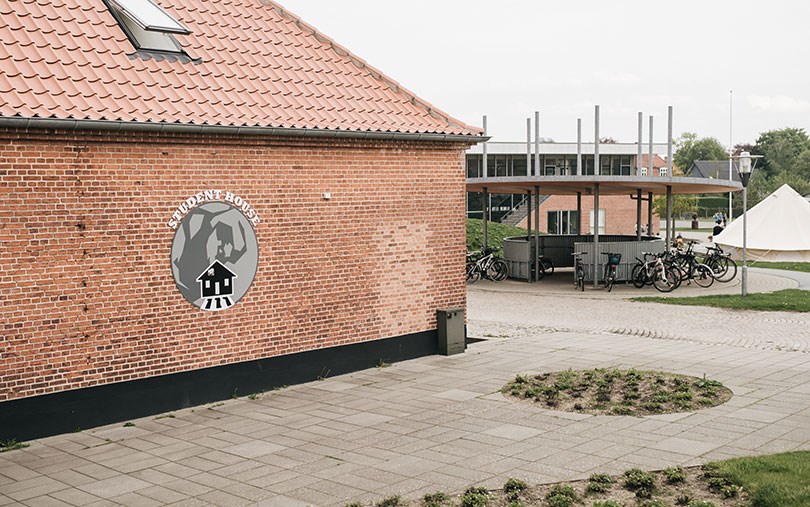
Just a short walk from campus, you'll find the Student House, where students from Dania Academy and VIA University College organise a wide range of social activities, including a monthly Friday bar and larger events throughout the year. You are welcome to join the activities – or even help organise them yourself.
Beyond campus, Viborg offers a charming city centre with historic streets, a vibrant shopping area, cosy cafés and restaurants, and plenty of bars where you can relax with friends after class.
For more information about accommodation, student life and career opportunities in Viborg, visit Career City Viborg (Karriereby Viborg).
Video
Housing and student life in Viborg
Artiklen fortsætter under billedet
 Live right next to campus – feel at home from day one
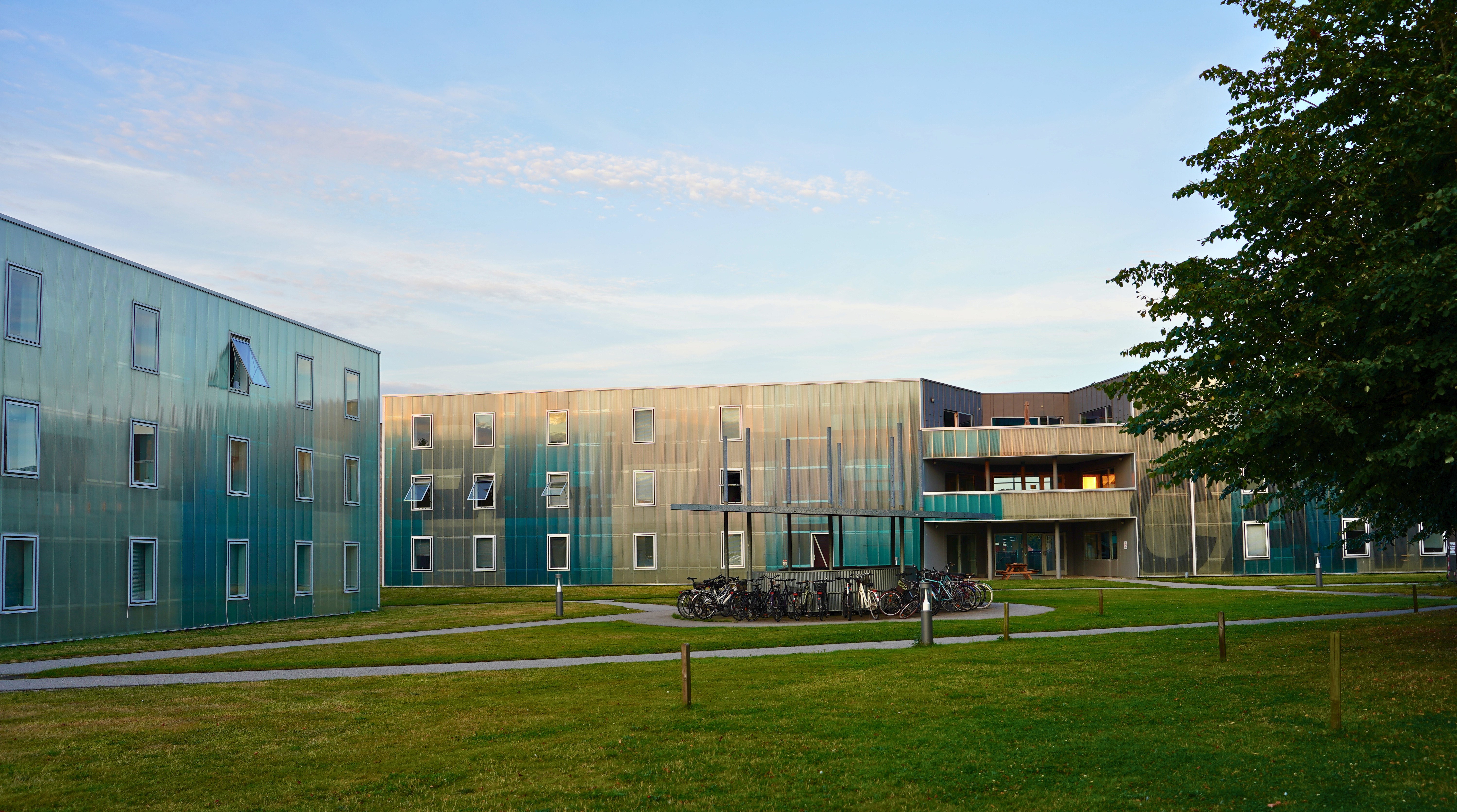
Live right next to campus at Camp Logos
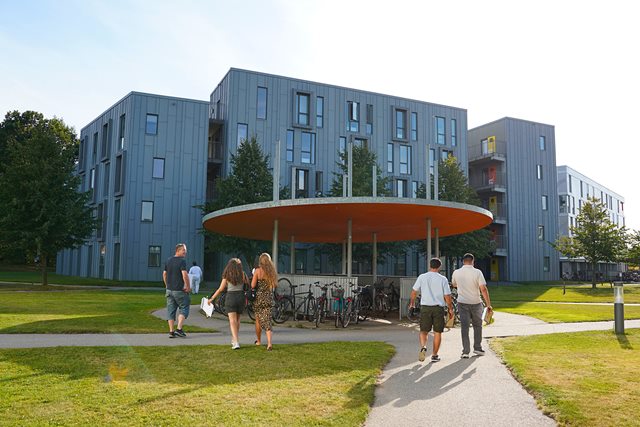
Moving to a new country is a big step, and having a comfortable place to call home can make all the difference. At Camp Logos you can live right next to campus alongside both Danish and international students, making it easy to become part of the student community from day one.
Camp Logos is located just across the street from Dania Academy, within easy reach of Viborg city centre, the stadium, fitness facilities and shopping.
Housing guarantee
If you are moving to Viborg to study, Viborg Municipality offers a housing guarantee. This means, you are guaranteed a place to live. Accommodation is normally available for move-in shortly before or around the start of your studies.
The dorm consists of five separate buildings; Alfa, Beta, Cato, Delta and Omega which are divided into different apartment types (see more here).
All rooms are furnished with bed, table, chair, lamp and have free internet access. Residents have access to outdoor facilities, including sports courts and a fire pit, as well as shared laundry facilities. There are storage rooms and a laundry room in the basements.
How to apply for housing
You must apply for housing as soon as you have been accepted into Dania Academy.
Dania Academy itself has no accommodation. However, we can offer general guidance on housing and help connect new students with Boligselskabet Sct. Jørgen, which owns Camp Logos, located directly on campus.
If you have any questions about housing or student life, please contact our student counsellors at international@eadania.dk
For more information about accommodation in Viborg, please contact the housing associations Boligselskabet Sct. Jørgen and Boligselskabet Viborg.

Study, live and feel at home in Viborg
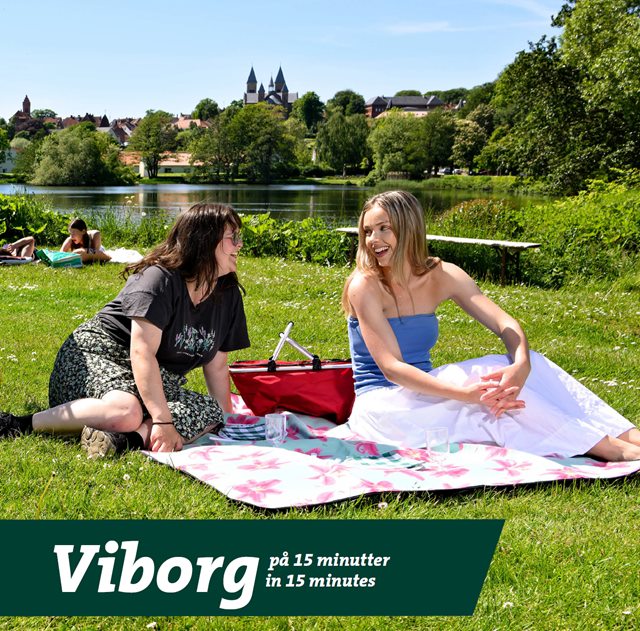
Viborg is a vibrant and welcoming student city where history, culture and nature come together.
The city offers a lively centre with cafés, restaurants, shops and cultural events, while beautiful lakes, forests and green spaces are always close by. It's easy to get around by bicycle or on foot, and you can quickly feel at home in the city.
With a diverse student community, excellent sports facilities and plenty of opportunities to meet new people, Viborg provides an inspiring and comfortable setting for your student life in Denmark.
Discover the best of Viborg
This booklet will give you a glimpse of the city’s hidden gems, exciting career opportunities, historical routes, and the many events that make the Viborg area truly special. We hope you’ll be inspired – and tempted to explore everything the area has to offer.
Artiklen fortsætter under billedet

As a graduate you will gain skills and competencies that are in demand across both private companies and public organisations.
Examples of career opportunities include:
- IT Security Consultant
- Cyber Security Specialist
- Security Analyst
- IT Security Architect
- Software Developer specialising in Cyber Security
- IT Administrator specialising in Cyber Security
- SOC Analyst (Security Operations Center)
- Incident Response Specialist
- Information Security Coordinator or Information Security Manager
Practical matters
To help you get off to a good start in Denmark, here is some practical information you should know.
-
Campus canteen
Our spacious, open canteen at Campus Viborg serves delicious food and a selection of drinks at affordable, student-friendly prices.
-
Permits: How to get residence permit and CPR number
If you are staying in Denmark for more than 3 months you will need a residence permit and a CPR number (personal identification number). Your CPR number enables you to get health insurance in Denmark.
When arriving in Denmark, you must be issued with a CPR number and an EU residence document (only EU/EEA students). Non-EU students should have their residence permit/visa before they arrive in Denmark.
We will explain the procedure in much more detail during our Orientations Days and assist you in the whole process. -
Tuition fees
There is no tuition fee for:
- Danish students
- Students from the EU/EEA countries
- Students with a permanent residence permit in Denmark
- Students with a temporary residence permit with the possibility of obtaining a permanent residence permit in Denmark ('mhp. varigt ophold' or 'mmf. varigt ophold')
- Students with a temporary residence permit with reference to the following paragraph: §7 stk. 1, 2 & 3; §8 stk. 1 & 2 ; §9 stk. 1 ; and §9c stk. 1
All other students must pay full tuition fees.
Tuition fees for non-EU citizensStudents are required to pay a tuition fee. More details on this will follow.
Contact us
We will gladly answer your questions. Please feel free to contact us.
Was this article helpful?